Thursday, March 26, 2009
What AIG Wants . . .
Wednesday, March 25, 2009
Complacency Already?
By Steve Geimann
March 24 (Bloomberg) -- Federal Deposit Insurance Corp. Chairman Shiela Bair said steps to help the financial industry are working, and some banks are starting to make money.
“We are seeing some signs of thawing,” Bair said in an interview on Bloomberg Television. “Many banks are making money.
‘‘I’m starting to get more optimism,’’ Bair said.
Non-Defense Durable Goods Orders Plummet Year on Year
Another Call for a Pecora Commission
Whatever happened to the law (Title 12, Sec. 1831o) mandating that banking regulators take "prompt corrective action" to resolve any troubled bank? The law mandates that the administration place troubled banks, well before they become insolvent, in receivership, appoint competent managers, and restrain senior executive compensation (i.e., no bonuses and no raises may be paid to them). The law does not provide that the taxpayers are to bail out troubled banks. Treasury Secretary Paulson and other senior Bush financial regulators flouted the law. (The Office of the Comptroller of the Currency (OCC) and the Office of Thrift Supervision (OTS) are both bureaus within Treasury.) The Bush administration wanted to cover up the depth of the financial crisis that its policies had caused.
Mr. Geithner, as President of the Federal Reserve Bank of New York since October 2003, was one of those senior regulators who failed to take any effective regulatory action to prevent the crisis, but instead covered up its depth. He was supposed to regulate many of the largest bank holding companies in the United States. Far too many of these institutions are now deeply insolvent because the banks they own are deeply insolvent. The law mandated that Geithner and his colleagues place troubled banks in receivership long before they became insolvent. Why are the banking regulators, particularly Treasury Secretary Geithner, continuing to disobey the law?
We need a Pecora investigation
We can understand now why the administration and so many committee chairs are virulently opposed to the single most essential step we need to take to diminish future crises -- a modern Pecora investigation. Pecora was the prosecutor hired by the Senate banking committee to investigate the misconduct that helped cause the Great Depression. You must vigilantly study past failures to learn causation and to enact remedies. If we were dealing with a crisis of airplane crashes and someone opposed studying the causes of the failures we would (correctly) label him a lunatic. Congress largely stopped conducting meaningful oversight hearings of financial regulation during the Bush administration. The results were horrific. It appears that only intense public pressure will suffice to overcome congressional and administration resistance to a Pecora investigation. I hope readers will add their voices to this call.
We have a law that says when banks are at or near insolvency private shareholders should be eliminated unless we can arrange a transaction that has no cost to the FDIC. Receiverships produce "private institutions." The FDIC manages the failed institution only long enough to get it in shape to be sold at the least cost to the taxpayers. Receiverships end unnecessary bailouts of private shareholders, reducing the cost to the FDIC, as the law requires. Receiverships place banks back in the hands of new shareholders. Geithner has so twisted the framing of this issue that he is warning that a cheaper, more effective means of resolving failed banks used under President Reagan is some alien form of socialism that President Obama must slay before it destroys capitalism. Geithner is channeling Rove when he conflates receiverships with "nationalization."
Secretaries Paulson and Geithner subverted the PCA law by allowing failed banks to engage in massive accounting fraud (which also means they are engaged in securities fraud). Treasury is telling the world that resolving the failed banks will require roughly $2 trillion dollars. That has to mean that the failed banks are insolvent by roughly $2 trillion. The failed banks, however, are reporting that they are not simply solvent, but "well capitalized." The regulators flout PCA by permitting this massive accounting and securities fraud. (Note that by countenancing this fraud they make it extremely difficult to ever prosecute these elite white-collar frauds.)
Under the current Obama-Geithner plan, all the burden falls on taxpayers, except for the minor exception that dividends on common stock have been cut. An obvious and major subsidy is inherent in the bailout proposal, as it guarantees above-market pricing for the bad securities the financial institutions hold. Further, there are massive conflicts of interest here. Blackrock, in which Bank of America has a substantial stake, is going to be a major bidder (read purchaser) of these securities. How on earth can Blackrock be allowed to take part in this?
If you would like to see more current commentary on the Obama-Geithner bailout plan, Mish has had a recent series of posts that are harshly critical, most recently wondering how on top of all the mess he has made as head of the New York Fed for years and now as Treasury Secretary, Mr. Geithner can request sweeping powers to bail out or close down whatever companies he wants with minimal checks and balances ("Geithner's Arrogance Knows No Bounds").
Finally, now that the headlines have moved away from AIG, the compensation diversion is petering out in the Senate. This has been a largely successful tactic so that there was no focus on the real scandal, the tens of billions of dollars that went to AIG's gambling buddies (many of them foreign) to make them whole dollar for dollar.
The Fed today is beginning open-market purchases of Treasuries. Also in the news is that the sale of 40-year bonds by the Government of the United Kingdom failed to attract bids for as much as was on sale, thus representing a failed auction for the first time in 14 years.
In the U. S., production of automobiles and homes is at levels last seen decades ago. Even if they rebound, so what? As with so many other matters, this is just not supposed to happen. Period.
This is such an extreme environment that in deciding what to do with investments, business tactics and strategy, and the like, reasoning from historical analogy makes less sense than usual.
Copyright (C) Long Lake LLC 2009
Tuesday, March 24, 2009
Tuesday Afternoon Markets Update
The S&P 500’s gain yesterday pushed the index’s increase since sinking to a 12-year low on March 9 to 22 percent, the steepest two-week advance since 1938.
The S&P 500 needed only 10 days to enter a bull market after taking seven weeks to fall 20 percent and give President Barack Obama a bear market.
Banksters of the World Unite: Set Our Bonuses Free
Austan Goolsbee, of the White House Council of Economic Advisers responds to Paul Krugman on Hardball. (ht (= hat tip) David)
A couple of comments: Goolsbee claims "if the private guy makes money, the government makes money. If the private guy loses money, the government loses money." Goolsbee is correct on an individual pool, but investors can buy multiple pools and Nemo has an excellent example of how the investors can make money, and the government lose money.
Goolsbee should read that example.
At 4:40 Goolsbee essentially agrees with Krugman's column:
[T]he Geithner scheme would offer a one-way bet: if asset values go up, the investors profit, but if they go down, the investors can walk away from their debt. So this isn’t really about letting markets work. It’s just an indirect, disguised way to subsidize purchases of bad assets.It's not a complete one-way bet on any individual pool because the investors do put a small amount of money down - and that small amount is at risk. But Krugman was referring to the non-recourse debt and he is correct.
BTW, Tanta once ripped Goolsbee - very funny: Dr. Goolsbee: I’ll Stop Impersonating an Economist If You Quit Underwriting Mortgage Loans
The administration's initial approach contrasted with those of the last two White Houses. Robert Rubin left Goldman Sachs Group to become one of Bill Clinton's top economic advisers, and convinced the new president that what was good for Wall Street was good for America. Under President George W. Bush, the administration "looked up to and admired Wall Street," says one banker. "The Obama folks don't even like us."
(DoctoRx here.: But that's all over now. Hundreds of billions in Federal money is much better than "like". It's true love.)
Goldman Sachs President Gary Cohn saw the contrast in person when he visited Chief of Staff Rahm Emanuel in early March. Goldman executives wanted to be part of the dialogue reshaping their industry, according to one Goldman executive. Instead, Mr. Emanuel lectured about how Wall Street "mispriced risk" and then expected Uncle Sam to pay the price for it. "My shareholders are called taxpayers," said Mr. Emanuel, who had previously worked for about two years as an investment banker.
The article concludes:
The banks' message: If you want our help to get credit flowing again to consumers and businesses, stop the rush to penalize our bonuses.
(DoctoRx here.: That's why they call them banksters!)
Monday, March 23, 2009
More on Treasury's Plan for Toxic Assets
Reactions:
- FT Alphaville: At the heart of this complex plan is liquidity, which Geithner has identified as both the problem and the answer. Increase liquidity and assets price will rise towards fair value, banks’ capital ratios will improve and they will start lending again. What if value of assets is low because of reduced cash flow expectations--> see also 'Fire-Sale' Vs. 'Hold-to-Maturity' Prices: Is The FASB Yielding To Pressure From The Industry?
- Alea: The plan is good in theory as private investors have no incentive to overpay because they are in a first-loss position. However, there is likely to be a gap between the mtm value of the toxic assets and what a rational investor would pay, reducing or eliminating the incentive for banks to participate. Only the truly cash-starved banks will jump.
- Blog comments: private investors will take long positions in the selling banks’ stocks (or other long positions in derivatives) and will then have an incentive to grossly overpay for the securities in this program. They’ll gladly take some losses in this program to boost their other positions outside the program.
- Krugman: Huge taxpayer subsidies to the private sector are involved: Suppose that there’s an asset with an uncertain value: there’s an equal chance that it will be worth either 150 or 50. So the expected value is 100. But suppose that I can buy this asset with a non-recourse loan equal to 85 percent of the purchase price. How much would I be willing to pay for the asset? The answer is, slightly over 130 [in a competitive auction.] Why? All I have to put up is 15 percent of the price — 19.5, if the asset costs 130. That’s the most I can lose. On the other hand, if the asset turns out to be worth 150, I gain 20. So it’s a good deal for me.
- cont.: Another way to say this is that by financing a large part of the purchase with a non-recourse loan , the government is in effect giving investors a put option to sweeten the deal.
- John Mauldin (via TechTicker): I'm in the hedge fund business myself but as a taxpayer I don't believe Treasury should subsidize hedge funds.
“My gut reaction is that this is an excellent plan. This plan will go a long way toward getting banks in better position to lend more aggressively and break the deleveraging feedback loop that is now in place."I think this is a myth that banks will lend "more aggressively" once the toxic assets are off their balance sheets. To whom? Perhaps Anderson is making the moral hazard argument here - maybe he is saying since the banks (and their investors) are being bailed out with above market prices for toxic assets that they will once again engage in risky lending. I hope that isn't his argument.
Scott Anderson, senior economist, Wells Fargo
The key problem with the Geithner plan is that it incentivizes investors to pay more than market value for toxic assets by providing a non-recourse loan and with below market interest rates. (See Krugman on the price impact of a non-recourse loan). The investors do not receive this incentive, the banks do. And the taxpayers pay it, so this is a transfer of wealth from taxpayers to the shareholders of the banks.
March 23, 2009
The PPIP: It's NOT the Liquidity, Stupid. It's the Marks.
You can say something about the current Administration: they are really trying. The recently released Public-Private Investment Program ("Program") details show both a lot of thought and some really good ideas. Unfortunately, the essence of the Program and its messaging are still missing the boat on a few important fronts. The main issue: the Government perceives the problem to be one of investor liquidity and the ability to finance broken asset portfolios. The problem is that they are wrong. It is all about banks not wanting to own up to inflated balance sheet values. But here are some other problems with the Program and its positioning:
- Still enamored with short-term stock market movements. Larry Summers stated that the Administration is "gratified" by the stock market's reaction to the Program. Why, oh, why, do Senior Government officials, especially those with ostensibly high IQs, say such stupid things? Guys, the focus should be on doing the right thing for the long-term, not on what will goose the market for a day or two. And while Summers et al claim to be all about the long term, then why do they keep on talking about stock market reactions to policy decisions? If there is one thing we know for sure, it's that the market is very, very jittery and volatile, and is apt to make sharp moves in response to almost any news. While the Dow could rally 500 points today, it could just as easily fall 500 points if liquidity fears rear their ugly head, another bank runs into trouble, populist rantings by Congress spook the markets, Pandit is given a long-term employment contract, etc. Bottom line: the Administration needs to stop talking about and caring about short-term stock prices. Stock prices are not unlike the Treasury yield curve: easy to manipulate on the short-end, difficult if not impossible to impact for a sustained period on the long end.
- Forgetting the appetite of the supply side. The Program, with all the benefits provided to approved buyers - equity matching funds, cheap leverage, etc. - lists only a single line when addressing a key weakness: Participant Banks don't actually have to participate. Participant Banks can submit portfolios for auction, Approved buyers can line up, valuation firms can estimate the worth of portfolios submitted for auction, buyers can submit their bids and Participant Banks can say: no. I fail to see how the Program is a material departure from the current landscape, except for the fact that the Government is providing cheap financing. The buyers are still running equity risk regardless of the 1-1 Government match (as they should), and will only submit bids that reflect their assessment of risk and return. This may result in prices that are still far out-of-line with current bank carrying values, causing banks to reject the highest bids in a move to avoid further asset write-downs. So even a protracted auction process could result in a whole lot of nothing. What does Larry Summers think a failed auction will do to stock prices? I shudder to think.
- Perpetuating entrenched and failed managements. The Program is a vehicle for helping broken firms liquify broken asset portfolios. What it doesn't do is help broken firms get rid of broken managements that got us into these problems in the first place. In the rush to protect major lenders from going out of business (and protecting stockholders and debtholders in the process), the US taxpayer is given scant protection from the cadre of poor leadership teams that led firms into troubled waters. Why is AIG the sole whipping boy for the Government when plenty of other firms were complicit in damaging the financial system? While legacy AIG management deserves much of the scorn they've received, most broken bank executives have gotten off with nary a scratch. This I do not understand.
- Not reflecting the true magnitude of the Government's involvement in the numbers. If I read the materials properly, it seems as if the only money being counted against TARP are the equity matching funds being provided. What about the leverage being guaranteed by the FDIC? Depending upon the values realized for the purchased portfolios, those guarantees might come into play, increasing costs well beyond the equity commitments. This is more an issue of truth-in-advertising. While yes, having the private sector side-by-side is a good thing, the Government via the FDIC is providing the debt guarantee. If this isn't incremental exposure to the US taxpayer, then I don't know what it is. This needs to be clearly factored in as an explicit cost of the Program.
Geithner Unveils Public-Private Rip-Off Plan
Thoughts on the Vegetable Garden
They also gathered to relish their changing political fortunes, courtesy of the Obama administration.
“This has never been just about business,” said Gary Hirshberg, chief executive of Stonyfield Farm, the maker of organic yogurt. “We are here to change the world. We dreamt for decades of having this moment.”
After being largely ignored for years by Washington, advocates of organic and locally grown food have found a receptive ear in the White House, which has vowed to encourage a more nutritious and sustainable food supply.
The most vocal booster so far has been the first lady, Michelle Obama, who has emphasized the need for fresh, unprocessed, locally grown food and, last week, started work on a White House vegetable garden. More surprising, perhaps, are the pronouncements out of the Department of Agriculture, an agency with long and close ties to agribusiness.
In mid-February, Tom Vilsack, the new secretary of agriculture, took a jackhammer to a patch of pavement outside his headquarters to create his own organic “people’s garden.” Two weeks later, the Obama administration named Kathleen Merrigan, an assistant professor at Tufts University and a longtime champion of sustainable agriculture and healthy food, as Mr. Vilsack’s top deputy.
Mr. Hirshberg and other sustainable-food activists are hoping that such actions are precursors to major changes in the way the federal government oversees the nation’s food supply and farms, changes that could significantly bolster demand for fresh, local and organic products.
Sunday, March 22, 2009
Krugman: Obama Blowing His First and Last Chance to Set the Banking System Right
If you think it’s just a panic, then the government can pull a magic trick: by stepping in to buy the assets banks are selling, it can make banks look solvent again, and end the run. Yippee! And sometimes that really does work.
But if you think that the banks really, really have made lousy investments, this won’t work at all; it will simply be a waste of taxpayer money. To keep the banks operating, you need to provide a real backstop — you need to guarantee their debts, and seize ownership of those banks that don’t have enough assets to cover their debts; that’s the Swedish solution, it’s what we eventually did with our own S&Ls.
Now, early on in this crisis, it was possible to argue that it was mainly a panic. But at this point, that’s an indefensible position. Banks and other highly leveraged institutions collectively made a huge bet that the normal rules for house prices and sustainable levels of consumer debt no longer applied; they were wrong. Time for a Swedish solution.
But Treasury is still clinging to the idea that this is just a panic attack, and that all it needs to do is calm the markets by buying up a bunch of troubled assets. Actually, that’s not quite it: the Obama administration has apparently made the judgment that there would be a public outcry if it announced a straightforward plan along these lines, so it has produced what Yves Smith calls “a lot of bells and whistles to finesse the fact that the government will wind up paying well above market for [I don't think I can finish this on a Times blog (expletive deleted)]”
Why am I so vehement about this? Because I’m afraid that this will be the administration’s only shot — that if the first bank plan is an abject failure, it won’t have the political capital for a second. So it’s just horrifying that Obama — and yes, the buck stops there — has decided to base his financial plan on the fantasy that a bit of financial hocus-pocus will turn the clock back to 2006.
Yesterday . . . and Today
The Great Recession versus the Great Depression
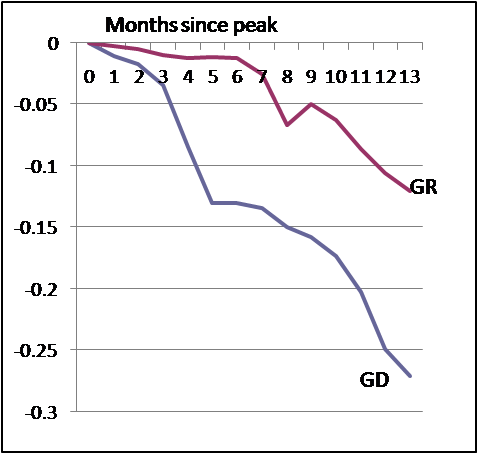
Reading this article about the global manufacturing plunge, I wondered: how does the current slump stack up against the early stages of the Great Depression? The US has consistent industrial production data back to 1919, so it’s a fairly straightforward exercise. Below is the change in industrial production, measured in logs, from the previous peak in 1929-30 and 2007-9.

At first, the current recession didn’t hit industrial production all that hard. But the pace accelerated dramatically last fall, so that at this point we’re sort of experiencing half a Great Depression. That’s pretty bad.
Clarification: Those are natural logs — sorry, economists use them so frequently I forgot to explain. So basically multiply by 100 to get the percent change.
Saturday, March 21, 2009
Listen to Sweden
'You can't think you can solve everything with taxpayers' money. Stimulus packages are already in place and taking us through this challenging time. We already have done a lot.'
In contrast, the Feds have decided to double down on their incoherent pretense that they love the banks but hate the bankers. Despite the diversionary witch hunt about AIG bonuses while not questioning the vastly greater giveaway to AIG, and imposing salary limits to a small number of executives under the TARP bailout plan, Treasury plans to expand the already trillion-dollar Federal Reserve TALF (Term Asset-Backed Securities Loan Facility) program.
The Fed, however, has conveniently exempted TALF from compensation limits.
All these Treasury and Fed programs represent employment for financial types.
We can learn a lot from the Swedes, who have been all over the place in their voyage into and somewhat out of socialism.
More precious than any given level of expenditures for cellphones, WIIs, movies, restaurant meals, two-five bathroom homes, etc., is the preservation of liberty and democracy as envisioned in the Declaration of Independence and the Constitution, as amended. Thus the greatest imperative is to protect the financial strength of the U. S. Government itself, while dealing directly with the growing homeless epidemic and the fiscal strains/crises at the state and local level.
One additional point.
The alacrity with which Congress imposed a 90% tax rate on these individuals at large financial companies is surprising and disquieting. Why no hearings? What's the rush?
This ginned-up AIG bonus "scandal", the payments for which were, a month ago, specifically allowed by the same "shocked" crowd that now is imposing this penalty tax rate, is so contrived that the suspicion has to be entertained that a la Hoover and then Roosevelt, much higher tax rates, perhaps at the same level, are going to be imposed on other "undeserving rich".
As more and more Ponzi schemes are uncovered all over the U. S. and the U. K., as Europe tries to have less of an increase in government involvement in the economy than does America, as the party in power in the U. S. points fingers within itself over the AIG flap, as Republicans join in the lynch mob, as corporatism continues to be official governmental policy, and as the economic Banana continues to inevitably worsen in the months ahead, all the geniuses who look to the great majority of post-Great Depression economic cycles to guide their decisions and recommendations are making a big mistake. The current crisis is more like the really bad scenes:
The stock market kept going down despite tremendous public angst all throughout 1973 and 1974, bottoming a full 24 months from the peak in December 1972 only after the Watergate and OPEC crises were completely decided and the Viet Nam crisis was almost completely over.
The about 32 month waterfall decline in 1929-32 and the 1973-4 stock market and economic fiascoes strike this observer as better historical examples.
The public's anger at the Big Government/Big Finance alliance is palpable and growing. This does not bode well for the markets in the short term.
Copyright (C) Long Lake LLC 2009