Showing posts with label Great Recession. Show all posts

Tuesday, April 3, 2012

Reinhart and Rogoff Fight the Fed

In 2009, Drs. Carmen Reinhart and Ken Rogoff published This Time Is Different: Eight Centuries of Financial Folly. This academic work became topical as it was nearing its completion due to the "Great Recession". They added a long ending chapter to deal with the crisis and predicted a great deal of what has transpired: several years of falling housing prices, shift of debts to the sovereign, slow employment gains well after the recovery began, among other things. They did this because they felt that the Great Recession was not different from other financial crises throughout history.

There is now revisionism at the Fed, which they rebut in a Bloomberg.com article published yesterday titled Five Years After Crisis, No Normal Recovery. Here are excerpts:

With the U.S. economy yielding firmer data, some researchers are beginning to argue that recoveries from financial crises might not be as different from the aftermath of conventional recessions as our analysis suggests. Their case is unconvincing.

The point that all recoveries are the same -- whether preceded by a financial crisis or not -- is argued in a recent Federal Reserve working paper by Greg Howard, Robert Martin and Beth Anne Wilson. It was also discussed in a recent article in the Wall Street Journal.

It is mystifying that they can make this claim almost five years after the subprime mortgage crisis erupted in the summer of 2007 and against a backdrop of an 8.3 percent unemployment rate (compared with 4.4 percent at the outset of the financial crisis).

Later, they strengthen their case:

What is striking about the Howard, Martin and Wilson Fed study is that it doesn’t really dispute our finding that recessions that financial crises are worse in terms of depth as well as duration. Instead, it argues that one should be more interested in a much narrower question: Once they begin, recoveries after financial crises are typically just as strong as those that follow a typical recession.

We admit that this time is different in one important respect: The goal posts many analysts use to assess economic outcomes seem to shift from data point to data point. When we first identified that financial crises were associated with severe recessions, the rosy-scenario crowd responded that the Great Moderation had smoothed the business cycle. Recessions in the new era were short and shallow.

After the crushing contraction, a new metaphor held that the harder the fall, the more vigorous the bounce back. Nonetheless, what followed was an anemic recovery that has yet to pull per capita annual real GDP back to the level of 2008.

Now, the staff of the Fed hopes to shift the goal posts yet again. Their advice is to forget about the problems of the past few years and focus on the coming expansion that they forecast using their own idiosyncratic interpretation of business-cycle dynamics across 59 countries.

Finally, they suggest that simply avoiding a recession or deceleration in economic growth might be the best we should hope for:

Is the U.S. on track to an ever brisker recovery in which the jobs numbers -- which have already turned from 100,000 to 200,000 a month -- start showing 300,000 or even 400,000 net new jobs a month?

Perhaps. We hope for good news at the end of the week when jobs numbers are released...

But considering the huge and rising debt levels in the U.S., and the very limited extent to which deleveraging has taken place in the household and government sectors, we would be pretty happy to see a few straight years of trend growth, even if that falls short of the V-shaped recovery that some see around the corner. It might happen, but the historical evidence is at best mixed.

To interpret, they are asserting that too many debts were incurred during the booms to make economic acceleration likely. Why were they incurred, and why were so many debts not self-liquidating? It is difficult not to point to central bank stimulative policies as a key reason, though of course the Fed does not act alone.

From an investment standpoint, strangely it can turn out that a muddle-through recovery that avoids other than the mildest of recessions (which might not be defined by the experts until it had passed) can continue to allow the permissive financial environment in which the different assets of bonds, stocks, and gold all appreciate in nominal terms. This in fact is what happened in yesterday's trading. It is an unstable equilibrium, but it is precisely what has been happening the past few years. Eventually these assets "should" have major trend divergences. When and how, or even if, these disparate markets go their own ways is the major question for longer-term investors that I see.

(An unrelated note: Over the weekend, I mentioned that I had sold most of my AAPL stock last week. The price fell late Friday, and a favorable iPad survey was released yesterday morning. I am a member of the group that was surveyed, and the members-only data that was not released publicly was also quite strong for Apple. Thus I took advantage of the dip and bought back in. From here on, because this site is not a stock site, I am not going to comment on short-term trading, and regret that I mentioned it.)

Monday, August 9, 2010

Fearing the Bear, but Who Knows Where and When?

The stock market feels a bit like the economy- creepy if one looks at the linked chart and clicks on the 5 yr button. My interest is in the July 2007 period till now on the 10 year bond.

What my eye sees is a steady downtrend in rates with some variations from trend: the initial accelerated drop in rates in the second half of 2007 related to the sudden Fed moves, then the post-Lehman collapse in rates at the end of 2008, and the overshoot upward in rates this year just as various economic indicators proved to be peaking or to have peaked.

Bill Gross is looking at ZIRP through perhaps 2013, which is to say (scream): Japan! Japan! Japan! (Sort of the opposite of Tora! Tora! Tora!)

And Consumer Metrics, which claims to lead GDP by 1-2 quarters, just reported that July was so bad that only one month in the 2008-9 cycle was worse; and just by a smidgen. Even worse, CM's average reading for the first 7 days of August is more than a point below that lowest level in the Great Recession (assuming it is over), which occurred in August 2008.

And we all know what happened to stocks beginning late in August 2008 and thereafter.

I feel about stocks on trend, though not in degree, the way Nassim Taleb says he felt about Fannie and Freddie when he was shown a balance sheet analysis of them in, perhaps, 2001 or so. He recounts that he predicted disaster, but had no idea when that would occur. He just thought they were risky and way overvalued.

My sense on stocks is not that the market goes to zero the way a 100:1 leveraged mortgage company can go to zero, but rather that the stock market is over-promoted and that far too many companies that are called "blue chips" in fact have no, or negative, tangible book value. This is a result of stock buybacks, debt-based acquisitions, various accounting maneuvers, and of course value that does not appear on the balance sheet. But the beauty of Smithers' analysis is that he considers both earnings and tangible asset values. These usually agree, and now each is suggesting that the S&P 500 is about 50% overvalued.


In other words, pros know that earnings are only one of several ways to value companies, but CNBC et al focus almost exclusively on a non-GAAP measure of earnings called "operating earnings", which as you know means whatever a company wants it to mean. Let's say business shrinks for a product line and a production facility must be closed ahead of schedule. The company will say that's not a normal cost of doing business and try to exclude it from the public's evaluation of its earnings. But those unpredictable downside costs are just as valid as the occasional earnings beat because customers double-ordered due to fears of a product shortage!

Because it's not easy for either of Smithers' measures (q and CAPE) to change fast, the way the stock market can get to his view of fair value within the next several years can only be by declining. There is really no other way. Now it may never get to fair value, of course, but on the other hand a sober view of his chart shows that overvaluation periods have alternated with undervaluation periods.

I invest based in good measure on the principle of reversion to the mean, though looking at momentum and fundamental factors as well. But I believe that one should never ever fight the principle of mean reversion.

For stocks and the real economy, there is unfortunatley no New New Thing; war seemingly without end in Asia continues; most important recent IPOs have been of Chinese companies it would seem; and for the most part the average stock or index fund just allows one a powerless, tiny minority share in companies that care about their insiders before they care about their public stockholders.

And if states and the Federal government actually balanced their budgets, either by spending cuts or tax increases, what would happen to corporate profits???

Given that no one can answer that question (which of course is wildly theoretical), the entire economy and therefore the valuation of stocks is based on more speculation than usual. To value stocks on the basis of zero short-term cost of money is crazy, as we know from Japan that chronic ZIRP has led to numerous stocks selling well under tangible book and for less than quick liquidating value; and their stock market now yields far more than their 10-year government bond. Meanwhile our 10-year still yields about 40% more than the S&P 500 as a whole.

All this is with the backdrop in which the financial class that has been treated so well by the government the past many years moans about "deflation" and somehow thinks the central bank of the United States can make their lives even better than they are now while every survey of real people shows that the recession/depression continues.

What I'd rather do than buy the stock market when it is priced for a boom when there is actually the opposite of a boom going on is to buy stocks after chronically depressed economic times have persisted when stocks are priced for said bad times to continue. Think 1921, 1948, 1982 (see Smithers' chart). Not 2010.

In my opinion, one has to be very quick and agile to gather rosebuds from buying into this stock market. Too many thorns . . .

Copyright (C) Long Lake LLC 2010

Friday, January 29, 2010

Paul Krugman and Tired Old Thinking

In today's NYT column March of the Peacocks, Paul Krugman lays out the progressive/liberal view that government is the ultimate actor in the economy:

The nature of America’s troubles is easy to state. We’re in the aftermath of a severe financial crisis, which has led to mass job destruction. The only thing that’s keeping us from sliding into a second Great Depression is deficit spending. And right now we need more of that deficit spending because millions of American lives are being blighted by high unemployment, and the government should be doing everything it can to bring unemployment down.

This view is open to dispute. The 1929 downturn became a "great" depression during the unprecedented activism of President Hoover, and involved post-WW I debt repayments imposed on Germany as a unique complicating factor. In another sense, the Great D involved a series of events that comprised a perfect storm.
Think of it as a Hurricane Katrina which before the levees gave way, first made a direct hit on New Orleans and devastated it; and then the levees broke. A truly "perfect" storm.

And re the Great D, also remember that candidate FDR harshly criticized Hoover's Federal deficits, and pledged to bring the budget back into balance.

There is no replaying history. No one can disprove the concept that had FDR kept his pledge, the economy would not have recovered just as it recovered from the severe depression of 1920-21 or the Panic of 1873.

All we know is that in the 1930s, the government had a balance sheet that was a fortress founded both on gold and on untapped taxing and borrowing power.

This situation is quite different today, thanks to generations of Krugman-praised policies. The consolidated balance sheet of the Federal Government shows, let us say, $60 T of debt against $2 T of income. That's a 30 to one leverage ratio, and only includes the present value of Social Security and Medicare obligations. It excludes other obligations such as the financial backstops for FDIC and the like, and other implicit obligations.

Why a solution that was tried in the 1930s is the same solution that should be tried after decades of increasing debt and chronic price inflation is unclear. Something about Einstein's definition of insanity being doing the same thing and expecting a different result.

Moving to the recent past, there is no evidence that the disorderly bankruptcy of Lehman Brothers was going to lead to anything worse than we got.

Going farther, remember that one year ago, Mr. Obama's advisers were forecasting 8.5% peak unemployment in the absence of a massive deficit-spending "stimulus" bill.

Were these top-tier economists off by, say, an additional 15-20% unemployment points (these numbers are all U-3 for consistency)?

Could it be that all the activist government--cap and trade and then healthcare reform, for example--inhibited animal spirits amongst small business owners?

Yours truly has an only-partially tongue-in-cheek solution. Let us say that there is, net, 20% unemployment/underemployment (U-6 and then some). The average American with a job works 2000 hours per year. All one has to do is shorten the work week to 4 days, and poof, everyone has a job.

This solution is as obvious as simply taxing fossil fuel use directly rather than going to the sham of cap and trade.

In other words, go more European in work effort. Now, this can be spun in various ways: shorter work days, earlier retirement, etc.

In fact, the more leisure time people have, the more time they can spend consuming (not that consumption is the goal of life in richer countries). For sure, less work means more play.

Now, this is partly satirical, but only partly. America produces about 3000 calories of food a day for a population that needs, on average, only 2000. Our current solution is to stuff people with this overproduction, and the result is an obesity epidemic.

Less food production (less GDP) would be a good thing for our health, economy and environment. One can go down the list. Driving to work 4 days a week would save lots of gas, wear and tear on autos and roadways, and thus have positive aspects. In fact, working 4 ten-hour days a week would create savings over 5 eight-hour days.

In the real world where resources are finite, we need to think creatively and humanistically about practical approaches, not reflexively take Dr. Krugman's approach and turn to Leviathan for fixes.

Dr. Krugman is oriented toward government. In Europe, he would likely be a member of a Social Democrat-type party. Fine, legitimate point of view. But the key is to avoid imbalances such as massive deficits other than in wartime. A Great Recession caused by hot money, mortgage fraud and imprudent borrowing/lending simply does not get "solved" by repaving roads.

Two macro economic solutions are: Win a world war and thus dominate the global economy (the way out of the Great D); or deleverage at all levels (the post-WW II solution until leverage got excessive in the past decade).

Since a world war is not desired, the solution is to simplify our accounts, and as the world turns, commit ourselves to replacing debt with equity.

I would suggest starting with Citigroup.

The disagreement between Dr. Krugman and President Obama is one between similar thinkers. Both advocate government increasing its leverage to a greater extent than the rest of the economy is simultaneous decreasing its own.

There is no current cleared, trodden path away from this roadway, and until there is, I believe that the fundamental case for gold is strong and that new gold buyers can and will easily be found.

Remember: 30 to 1 leverage is a conservative measure of current Federal leverage. Sounds like Bear and Lehman to me. Paul Krugman thinks that raising this to 31 to 1 is the solution for 2010. Barack Obama perhaps prefers 30.8 to 1. I favor bringing it down an order of magnitude to, say, 3 to 1, and then going below that, and rethinking all current economic dogma built on the alleged virtues of an ever-expanding gross domestic product.

Copyright (C) Long Lake LLC 2010

Friday, September 4, 2009

On Unexpected U-Turns and Priorities

The headline you thought you would never see, absent another Pearl Harbor: Obama Urged to Rally Support for War.

This within a few days of an address to Congress to rally support for healthcare reform, or health insurance reform, or whatever.

And both of the above when the economy is still apparently losing jobs, which to the average person is the only definition of "recession". If you have any doubts about that, ask George H. W. Bush and Bill Clinton ("It's the Economy, Stupid) circa November 1992, which turned on the economy about a year-and-a-half after the recession officially ended.

A reminder: It's still the economy, Mr. President.

Copyright (C) Long Lake LLC 2009

Tuesday, April 21, 2009

Why the SIGTARP Report Suggests Both Looting and that a Depression Is Underway

Today's Quarterly Report of the Special Inspector General for the Troubled Asset Relief Program is quite troubling.  Early on, it summarizes matters:

The Troubled Asset Relief Program (“TARP”) now includes 12 separate, but often inter-
related, programs involving Government and private funds of up to almost $3 trillion
— roughly the equivalent of last year’s entire Federal budget. From programs involv-
ing large capital infusions into hundreds of banks and other financial institutions, to
a mortgage modification program designed to modify millions of mortgages, to public-
private partnerships purchasing “toxic” assets from banks using tremendous leverage
provided by Government loans or guarantees, TARP has evolved into a program of
unprecedented scope, scale, and complexity.


Any effort this immense, "unprecedented" in peacetime, including the Great Depression, will only be done for a truly major catastrophe, not just a "recession".  Paul Volcker, who is still at least nominally allied with the Administration, uses the euphemism "Great Recession" to describe the current downturn.  Since the word "recession" was introduced solely for PR reasons and means what "depression" meant before the Great D, we must interpret his use of the term for what it is.  TARP is response to an economic depression.  

Re the looting charge, SIGTARP has already initiated almost 20 preliminary or full criminal investigations.  These may be non-trivial:

. . . the cases include large corporate and securities fraud matters . . . insider trading, public corruption . . .

In addition, six areas of audit are underway.  These include special mention of BofA and BofA/Merrill; all 9 initial TARP funds recipients; and the payments to AIG's counterparties.

SIGTARP is specially critical of Treasury's refusal to monitor what has happened to the funds given to large financial institutions in return for preferred stock.  On its own, SIGTARP looked into the matter and received significantly detailed responses as to what the companies had done with the funds, sometimes in "granular" detail.  Why has Treasury refused such a simple matter?

SIGTARP has numerous complaints about the PPIP, which will be thoroughly analyzed by other bloggers much more expert than I.

There will be multiple "bottom lines" in this mess.   It is clear that at best Chairman Bernanke incompetently misdiagnosed matters as rosier than they were.  I wonder if Big Hank Paulson also misdiagnosed things.  In my humble opinion, he knew exactly how bad things were, given that he had recently run Goldman Sachs, which more or less runs Wall Street.  He exposed himself by waiting for the crisis that he knew was coming after he put Fannie and Freddie into receivership, then making sure in a 2 1/2 page document to request immunity for any misdeeds he might be accused of doing in implementing TARP.  How well is he sleeping these days?  

We have had unprecedented stock market manipulation by the SEC, twice putting short squeezes on to harm those who (correctly) were shorting financial stocks, then taking the pressure off after insiders and favored institutions were allowed to unload a lot of stock at unfairly high prices.

We have a Democratic Congress that would not even investigate a Republican President for alleged contractor abuses in Iraq.  One has to worry about how much zeal it will have to investigate a Democratic President's Treasury Department, especially when the Treasury Sec'y has been the glue in this disaster all along.

What is going on has elements of the Great Crash, in its financial and economic dimensions; and Watergate, with its political dimensions; as well as the S&L fiasco writ large.  One cannot think of anything like this festering toxic mix within the past hundred or more years in this country.  In this situation, where Big Finance and Big Government have been lying both by commission and by omission, there is no way to use historical economic tools to predict the future.  We just do not know what we may not know, other than that as a pretty young bride said to Rick in Casablanca, the devil has the people by the throat. 

Copyright (C) Long Lake LLC 2009

Sunday, March 22, 2009

Yesterday . . . and Today

Yesterday, all my troubles seemed so far away
Now it looks as though they're here to stay
Oh, I believe in yesterday.

Suddenly, I'm not half the man I used to be
There's a shadow hanging over me
Oh, yesterday came suddenly.

-McCartney/Lennon

This post is about two yesterdays, the one we enjoyed 2 years ago and that left suddenly, pre-economic downturn; and the one America did not enjoy in the 1930s.

Dr. Paul Krugman had a brief blog on the current economic banana as compared with the Great D.  Considering that the major forward-looking indicators of economic activity predict much worse to come (and then currently predict several months of scraping along the bottom), the argument that what we are experiencing is not a milder version of the Great Depression may be very optimistic.

As Krugman explains at the bottom, to find the percentage decline in manufacturing for each downturn, multiply by 100 (12% decline for now vs. 27% then).  

Two more quick points.  One:  Our economy is less oriented to manufacturing now.  The current massive declines in exports of manufactured goods out of Asia demonstrate that the U. S. decline would have been much worse now had we not outsourced so much manufacturing.
Two:  There was a major  spurt in manufacturing in the 1920s, similar to that of the 1990s. Manufacturing and "non-house" consumption growth from 2002-7 were not at boom levels, thus a smaller fall-off in percentage terms would get to the same "baseline" or below trend levels. 

Here's the entirety of the Krugman posting from March 20:

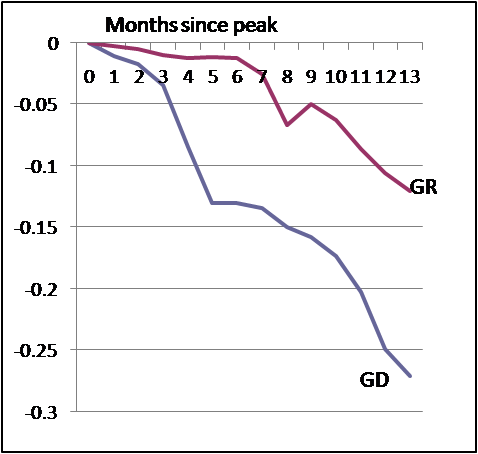
The Great Recession versus the Great Depression

Reading this article about the global manufacturing plunge, I wondered: how does the current slump stack up against the early stages of the Great Depression? The US has consistent industrial production data back to 1919, so it’s a fairly straightforward exercise. Below is the change in industrial production, measured in logs, from the previous peak in 1929-30 and 2007-9.

INSERT DESCRIPTION

At first, the current recession didn’t hit industrial production all that hard. But the pace accelerated dramatically last fall, so that at this point we’re sort of experiencing half a Great Depression. That’s pretty bad.

Clarification: Those are natural logs — sorry, economists use them so frequently I forgot to explain. So basically multiply by 100 to get the percent change.


Copyright (C) Long Lake LLC 2009 

Friday, March 13, 2009

Proud to be a DC-ian


Bloomberg.com's otherwise grim article "Jobless Rate Above 10% Defines Recession as Bernanke Predicted" describes partying along the Potomac:

Nationally, the jobless rate moved to a 25-year high of 8.1 percent in February.

The rate will reach 9.4 percent this year and remain above last month’s rate through at least 2011, threatening the nation’s longer-term growth potential, according to the median forecast of economists surveyed by Bloomberg News.

One exception to the grim data is in Washington, D.C., and neighboring Maryland and Virginia. The Obama administration may create 100,000 jobs to help administer the $787 billion economic stimulus package, said Max Stier, who runs the Partnership for Public Service, a non-profit group that monitors government employment.

With federal spending in the metro area increasing in 2009, as it has every year since 1983, that is trickling into the local economy, according to the Center for Regional Analysis at George Mason University in Fairfax, Virginia.

Sales at Morton’s steakhouse in downtown Washington are up almost 3 percent from the same time a year ago, said Dan Festa, 41, the general manager. The restaurant has hired nine servers since December, he said.

Business at Washington’s Ritz-Carlton hotel is comparable to two years ago, before the recession hit, said Elizabeth Mullins, who oversees four of the chain’s hotels.

“So far, touch wood, we’re lucky to be in DC!” Mullins said. “I don’t want to rub it in, but I’m so glad to be here.”

I'm so glad that she's so glad. Aren't you glad, too?

Thursday, February 26, 2009

Depression in Durable Goods

The Government has released data on durable goods orders.

New orders are down 26% from a year ago ( down 28% excluding defense-related orders).

"Primary metals": down 41%.

Computers and electronic products: down 15%. (The sub-category of computers and related products was down 27%.)

Non-defense aircraft and parts: down 83%.

Non-defense capital goods: down 31%.

Conclusion: We are in, at best, a Great Recession.

Copyright (C) Long Lake LLC 2009